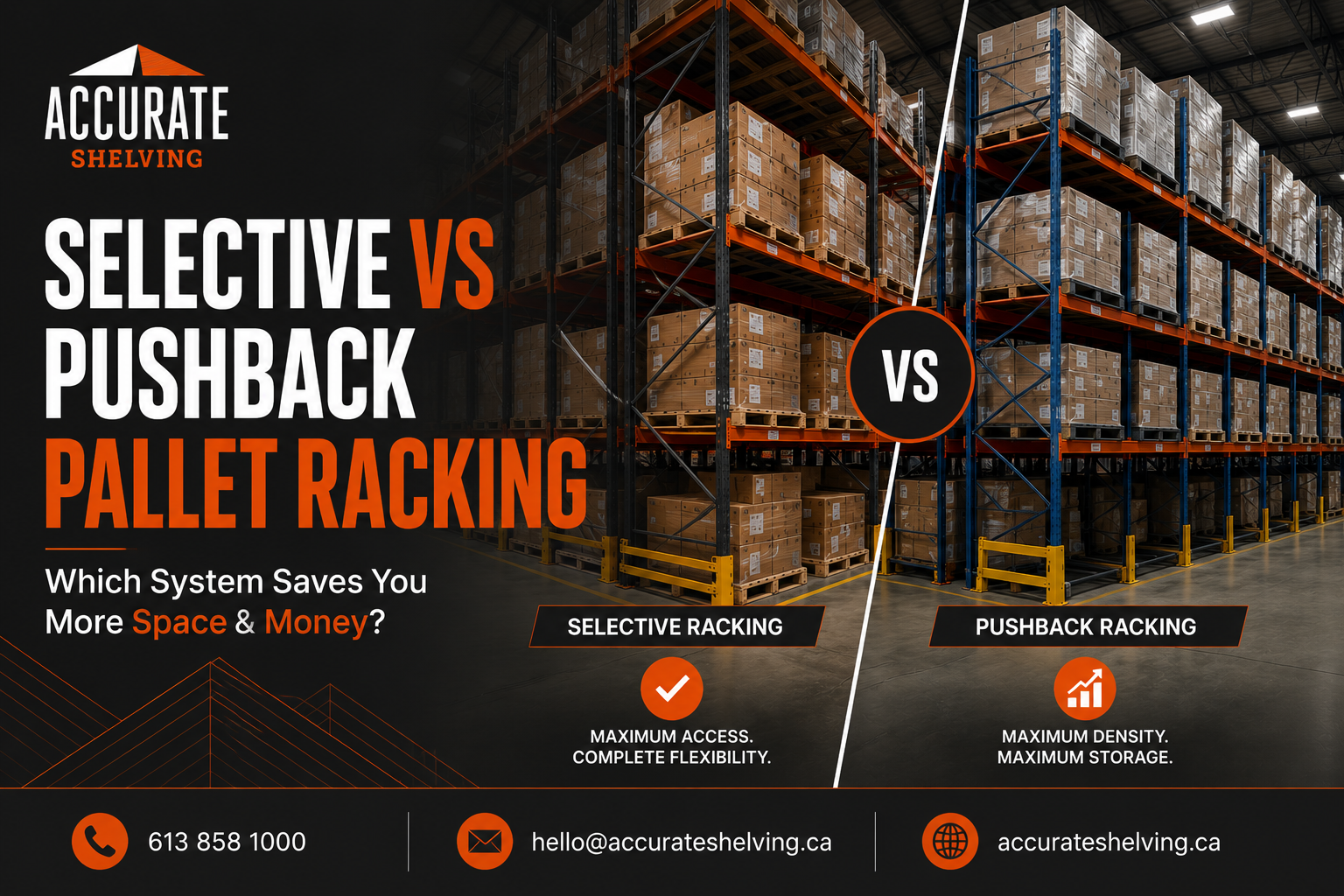
Your warehouse needs more storage capacity. You’re evaluating two systems: selective pallet racking and pushback racking. The choice isn’t which system is universally “best”, it’s which system fits your operation, your workflow, and your inventory patterns.
For foundational racking knowledge, read our Warehouse Pallet Racking guide. At Accurate Shelving, we’ve spent 21 years helping Canadian warehouses choose between these systems. Here’s what you need to know to decide correctly.
What Is Selective Pallet Racking?
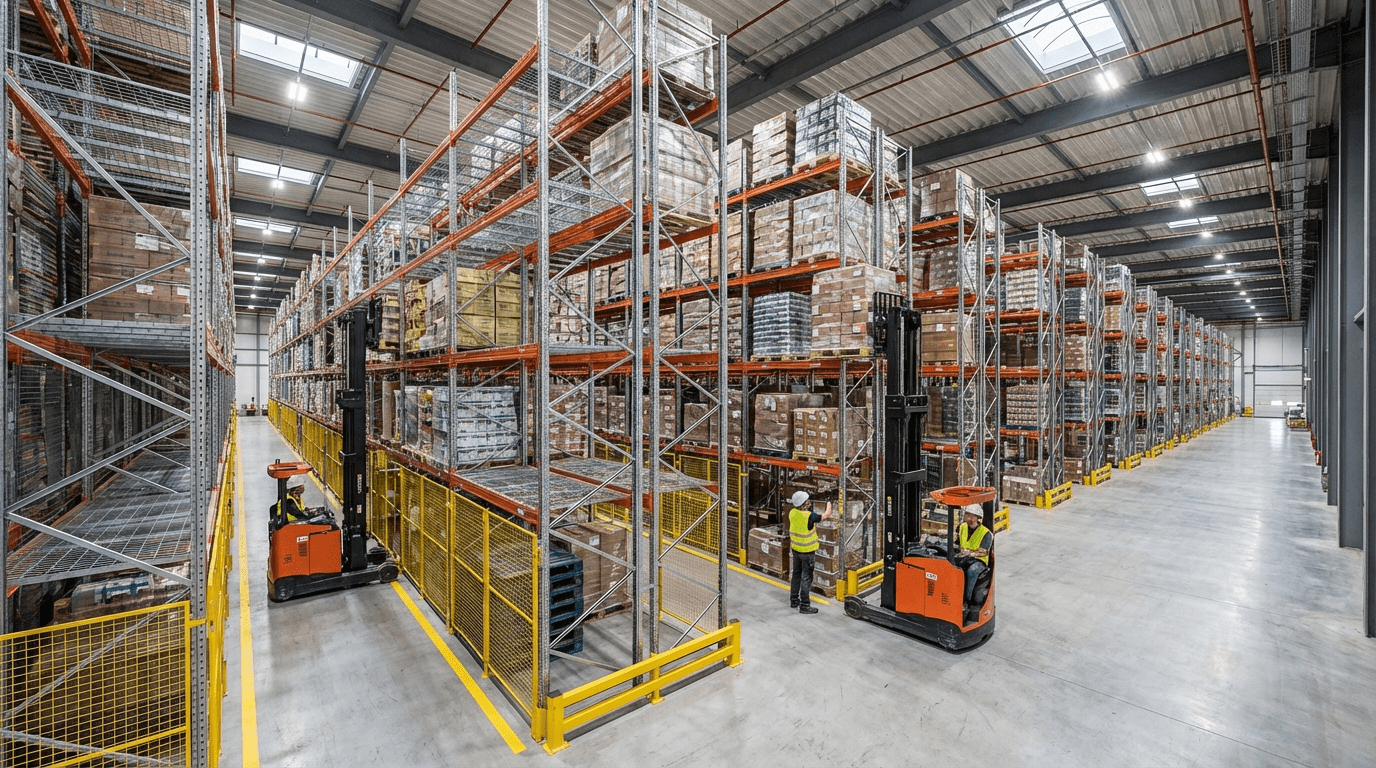
Selective pallet racking is the most common warehouse storage system in North America. Every pallet is independently accessible from the aisle, you can retrieve any item without moving others.
The system uses vertical upright frames connected by horizontal beams at adjustable heights. Forklifts navigate dedicated aisles and access pallets directly. This design allows immediate access to any pallet position without disturbing adjacent inventory.
How Does Selective Racking Maximize Storage Flexibility?
Selective racking stores pallets one-deep in rows with dedicated aisles between them. This design means any pallet is instantly accessible regardless of its storage position.
A forklift operator can navigate to any level and retrieve the specific item needed without rearranging other loads. No searching through storage lanes or moving adjacent pallets required.
The flexibility advantage matters most in operations with frequent inventory changes. If your product mix changes regularly, if you need to access different items or adjust storage heights selective racking adapts easily.
The horizontal beams are adjustable, so you can modify spacing as your products change. This adaptability prevents operational bottlenecks when warehouse needs evolve.
What Storage Density Does Selective Racking Achieve?
Selective racking typically achieves 60-70% space utilization, storing 200-250 pallet positions per 1,000 square feet. For 3,000 pallets, you’d need approximately 12,000-15,000 square feet of warehouse space. This density is lower than high-density systems like pushback, but the accessibility trade-off is intentional.
The space utilization percentage includes the aisles required for forklifts to navigate and access any pallet. The aisles take floor space but provide the direct access advantage. Different operations prioritize space differently, some need maximum accessibility, others need maximum capacity.
When Is Selective Racking the Ideal Choice?
Selective racking excels in warehouses with high SKU variety and frequent inventory rotation. E-commerce fulfillment centers with 5,000+ different products rely on selective racking. Retail distribution networks that constantly receive new products use selective systems. Any operation where you need random access to different items benefits from selective’s accessibility.
It’s also the standard choice for operations requiring FIFO (First-In-First-Out) rotation. If you handle perishable goods, pharmaceuticals, or items with expiration dates, selective racking lets you rotate inventory manually and maintain compliance. The ability to access any pallet at any time is essential for managing shelf-life requirements.
What Is Pushback Pallet Racking?
Pushback pallet racking stores multiple pallets in a single lane typically three to six deep. When you load a new pallet, it pushes existing pallets back along inclined rails. When you remove the front pallet, gravity automatically advances the next pallet forward. It’s like a spring-loaded inventory system where mechanics handle the work manually done in other systems.
How Does the Pushback Mechanism Actually Work?
The system uses inclined rails (typically 3-5 degrees) with rolling carts beneath each pallet. When a forklift loads a new pallet on the cart, it pushes the existing stack back smoothly.
The deeper pallets nest behind the front pallet in a natural sequence. When picking from the front, the system naturally creates a LIFO (Last-In-First-Out) access pattern. This mechanical simplicity is deceptively powerful.
The carts roll smoothly on the inclined rails, distributing the weight evenly across all positions. Operators need precise positioning skills loading incorrectly can cause carts to jam or pallets to misalign. But once trained, operators handle pushback systems efficiently.
The mechanical operation requires only standard forklifts, though operators benefit from clear training on the system’s mechanics.
What Storage Density Does Pushback Racking Achieve?
Pushback racking achieves 75-85% space utilization, storing 350-450 positions per 1,000 square feet. That same 3,000 pallets now requires only 6,500-8,500 square feet.
The capacity difference is significant compared to selective racking. Pushback stores substantially more inventory in the same footprint.
The higher density comes from eliminating individual aisle access for each pallet. Instead of wide aisles between rows, pushback uses fewer, narrower aisles. The space saved is dramatic for operations where capacity matters more than accessibility. Different warehouses need different solutions.
When Does Pushback Racking Make Business Sense?
Pushback works best in warehouses with low SKU counts and high-volume storage. Beverage distributors with 4-8 main products. Food storage facilities managing bulk inventory. Seasonal operations storing consistent products year-round. Any warehouse prioritizing density over accessibility benefits from pushback.
It’s also valuable for operations accepting LIFO inventory rotation. Since the last item loaded is the first accessed, pushback works perfectly for non-perishable goods that don’t require shelf-life rotation. Bulk commodities, manufacturing components, seasonal inventory, these all operate well in pushback systems.
How Do These Systems Actually Compare?
Both systems solve storage problems, but they solve different problems. Selective maximizes your ability to access any item instantly. Pushback maximizes your ability to store more items in less space. Understanding the real trade-offs helps you choose correctly for your operation.
Which System Stores More in Limited Space?
Pushback wins significantly here. It stores 40% more pallets in the same footprint. If your warehouse space is constrained, whether due to building size limitations, facility design, or space availability pushback’s density advantage is significant.
Selective racking requires more aisle space because every pallet needs independent access. This means your warehouse needs proportionally more non-productive floor area. Pushback reduces aisle requirements dramatically.
Instead of multiple wide aisles for selective racking, pushback uses fewer, narrower aisles. The operational footprint difference is substantial.
Which System Gives You Faster Access to Different Products?
Selective racking is faster for accessing diverse products. Any pallet is instantly accessible without moving others. In high-SKU environments, this speed advantage is crucial for order fulfillment and picking operations. Pushback requires sequential access, you must retrieve the front pallet before accessing deeper ones.
If your warehouse picks 500 orders daily with 300+ different SKUs, selective’s random access speed creates operational efficiency. If your warehouse picks 50 orders daily with 5 consistent SKUs, pushback’s sequential limitation doesn’t impact operations. Access speed matters differently based on your operational needs.
What About Inventory Rotation Requirements?
This is where the mechanical difference matters most. Selective racking supports true FIFO rotation you can access any product at any time, so you can practice strict first-in-first-out management. Pushback naturally creates LIFO access because the last item loaded is first accessed.
For perishable goods or pharmaceuticals requiring expiration date management, selective is essential. For durable goods without shelf-life concerns, pushback’s LIFO pattern is acceptable or even beneficial. Compliance requirements determine which system your operation needs.
Which System Works Best for Your Operation?
The right choice depends entirely on your situation. Understanding your needs helps you make the best decision. Let’s look at realistic operational scenarios.
E-Commerce with High SKU Diversity
A Toronto-based e-commerce company has 8,000 SKUs and needs 4,000 pallet positions. Random access to different products is essential. The warehouse picks 400 orders daily, and each order typically includes multiple SKUs scattered across the warehouse.
With pushback racking, operators would constantly need to access deeper storage lanes to find specific products. The sequential access limitation creates picking inefficiencies. Selective racking, with its direct access advantage, enables efficient picking and order fulfillment. The operational workflow favors selective.
Decision: Selective racking matches the operational requirements better.
Beverage Distribution with 4 Main Products
An Ontario beverage distributor stores 4 main products (beer, water, juice, soda) in high volumes. Product rotation is straightforward pallets arrive, move to storage, and exit when needed. LIFO access is acceptable because products don’t expire.
Pushback racking’s sequential access and higher density work efficiently in this scenario. The operation handles consistent, high-volume inventory of few product types. The mechanical simplicity and density advantages suit the operational pattern. The streamlined workflow favors pushback.
Decision: Pushback racking aligns with the operational workflow better.
Small Warehouse with High SKU Count
A mid-size distributor operates a 5,000 square-foot facility with 1,000 selective pallet positions. Adding 30% more inventory (300 additional pallets) is necessary. The facility has limited expansion space.
With selective racking, the warehouse needs approximately 1,500 additional square feet (6 pallets per 1,000 sq ft). With pushback, the same 300 pallets would fit in approximately 900 square feet. Pushback’s density advantage addresses the space constraint directly. The facility footprint limitation favors pushback.
Decision: Pushback racking solves the operational constraint more effectively.
How Do You Decide Between These Systems?
The decision comes down to four critical questions about your operation. Answering these honestly helps you choose correctly.
What’s Your SKU Count and Product Variety?
If you stock 1-10 main products, pushback can work efficiently. If you stock 50+ different products, selective becomes necessary for operational efficiency. Between 10-50 SKUs, evaluate your actual picking patterns.
If 80% of picks involve 20% of your SKUs, pushback could work. If picks are evenly distributed across products, selective operates better. The SKU count directly affects how efficiently each system works in your daily operations.
How Much Floor Space Is Available?
If you have abundant warehouse space, selective racking works well without operational constraints. If space is limited and you need to fit more inventory in existing square footage, pushback’s density advantage becomes significant.
The space available determines which system matches your constraints. Evaluate your actual space and growth projections to determine the operational fit.
Do You Need Strict FIFO Rotation?
If your products have expiration dates or compliance requires first-in-first-out access, selective is required. Pharmacies, perishable goods handlers, and regulated industries need FIFO capability.
If your products don’t expire and LIFO access is acceptable, both systems can work. Compliance requirements eliminate one option immediately. Check your industry regulations and product shelf-life requirements.
What’s Your Operational Complexity?
Selective racking accommodates more complex operations with varied workflows. Multiple departments with different storage requirements benefit from selective’s flexibility. Pushback requires disciplined, sequential access patterns.
If your operation is streamlined with consistent high-volume processes, pushback’s simplicity works well. If your operation has diverse needs, selective’s flexibility is essential. Evaluate how your daily warehouse operations actually function.
Real-World Proof: What Warehouses Are Actually Doing
Most successful Canadian warehouses use hybrid approaches. They implement selective racking for high-SKU areas and pushback for bulk goods. A 20,000 square-foot facility might dedicate 12,000 to selective for diverse products and 8,000 to pushback for seasonal bulk inventory.
This hybrid strategy captures selective’s flexibility where needed and pushback’s capacity advantages where applicable. It’s the realistic approach that large distributors and mature warehouses use. Different sections of the warehouse solve different operational problems.
Frequently Asked Questions
Can I combine both systems in one warehouse?
Yes, absolutely. Most warehouses over 10,000 square feet use hybrid approaches, dedicating selective racking to high-SKU areas and pushback to bulk goods. Different warehouse sections have different needs.
Which system requires more operator training?
Selective requires minimal training standard forklift operation works immediately. Pushback requires training on precise positioning and cart mechanics, though it’s not overly complex.
Can I switch from selective to pushback later?
Partially difficult. Pushback beams don’t fit selective uprights. Major switching would require new racking structure. Plan for your system based on long-term needs.
Which system has more moving parts?
Pushback has rolling carts and mechanical components that need occasional maintenance. Selective has minimal mechanical elements. Maintenance complexity differs between systems.
What if my inventory needs change over time?
Selective adapts more easily to changing needs because of beam adjustability and random access flexibility. Plan for your likely scenario but understand that selective provides more operational flexibility.