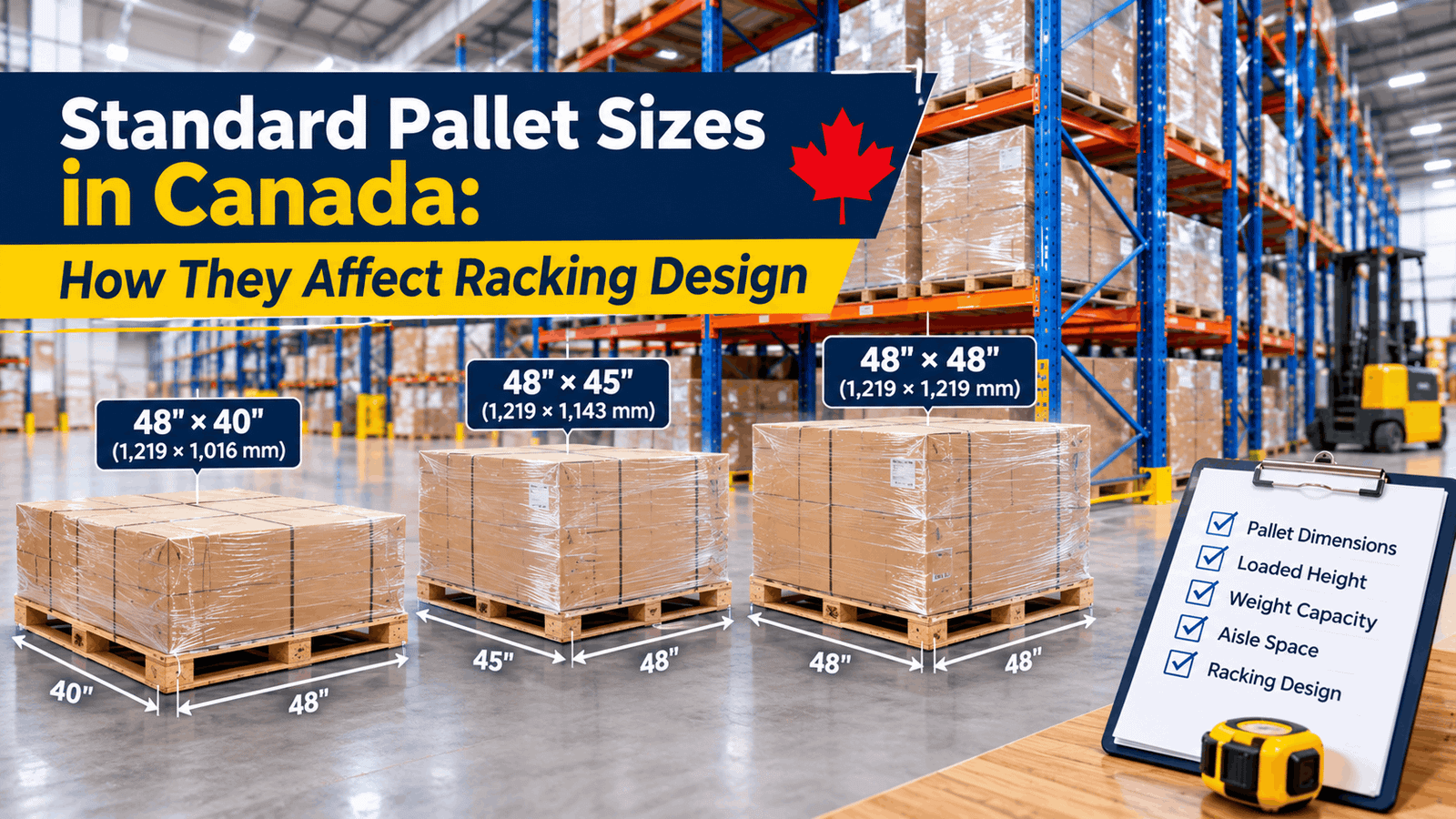
A common standard pallet size in Canada is 48 × 40 inches, approximately 1,219 × 1,016 mm. It is widely used across North American distribution, but Canadian warehouses also receive other footprints, imported pallets and custom designs.
At Accurate Shelving, we help businesses plan storage around their actual inventory. Choosing suitable pallet racking systems starts with understanding the pallet, its load and how both will be handled.
The footprint is only the beginning. Loaded height, product overhang, weight and pallet construction all influence whether a proposed rack arrangement will work.
What Is the Standard Pallet Size in Canada?
The 48 × 40-inch pallet is a familiar North American format, often associated with GMA pallet specifications. However, “standard” describes a commonly used footprint rather than one mandatory size for every Canadian operation.
What Are the Dimensions of a 48 × 40 Pallet?
Its nominal footprint measures 48 inches by 40 inches, or approximately 1,219 by 1,016 mm. These measurements describe the base area, not the height of the empty pallet or its load capacity.
Different pallets can share that footprint while having different deck boards, entry openings and construction. CHEP, for example, publishes separate specifications for its Canadian 48 × 40-inch stringer pallet.
Which Other Pallet Sizes Might Your Warehouse Receive?
Other footprints include 48 × 45 inches, approximately 1,219 × 1,143 mm, and 48 × 48 inches, approximately 1,219 × 1,219 mm. Canadian suppliers also offer custom dimensions for particular loads.
Imported goods may arrive on different platforms. An EPAL Euro pallet, for example, measures 800 × 1,200 mm. Receiving these alongside North American pallets creates a mixed-size storage requirement that should be identified before racking is specified.
What Should You Measure Before Choosing Racking?
Measure both the empty pallet and the complete loaded pallet. Together, the pallet, goods and packaging form the unit load that the rack must accommodate.
Measure the Pallet Footprint and Construction
Record length, width, overall pallet height and entry openings. Note whether it uses stringers or blocks and how the bottom deck is arranged.
Also record the intended storage orientation. A drawing showing which edge faces the aisle avoids confusion when discussing dimensions with a rack supplier.
Measure the Loaded Pallet
Record the widest and deepest points of the goods, including packaging or wrapping that projects beyond the pallet. Measure total loaded height and establish the total weight, including the pallet.
For example, cartons extending two inches beyond each side of a 40-inch-wide pallet create a 44-inch-wide load envelope. Planning around the empty pallet would overlook that additional space.
RMI identifies unit-load dimensions, weight, irregular shapes and product overhang as important information when specifying storage racks.
How Do Pallet Dimensions Affect Racking Design?
Pallet dimensions influence support, bay openings and handling space. The aim is to accommodate the load without compromising placement, withdrawal or the intended structural arrangement.
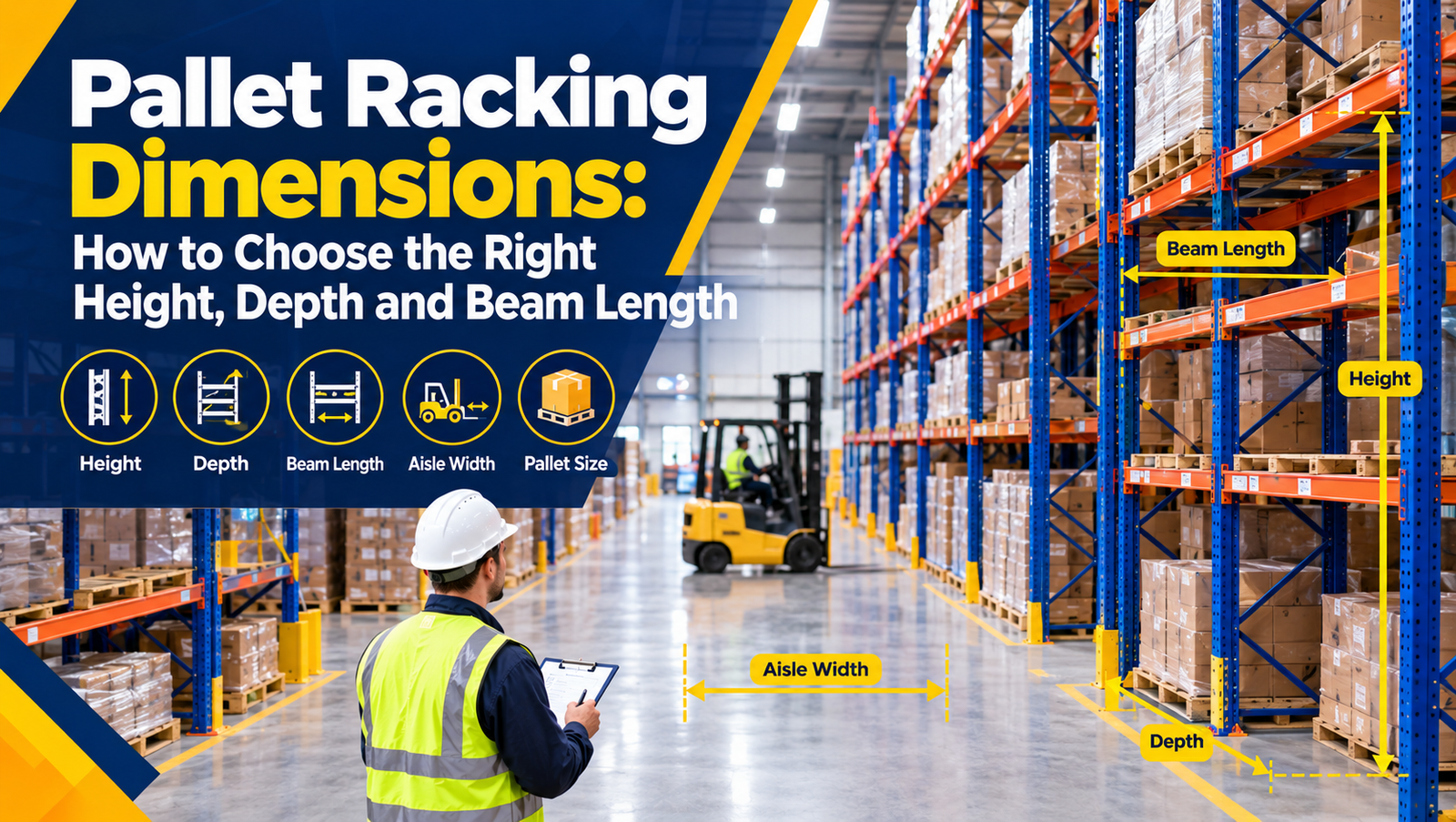
How Does Pallet Width Affect Beam Length?
A bay must accommodate the widest part of each load plus the specified clearances between loads and uprights.
Two pallets fitting side by side does not establish that the opening is suitable. Operators also need room to position and retrieve them without striking adjacent goods or rack components.
Beam length should therefore be selected around the complete load envelope and design requirements, rather than the description “standard pallet.”
How Do Pallet Depth and Orientation Affect Support?
Pallet depth and orientation determine how the pallet rests on the supporting beams. Its bottom construction must suit that support arrangement.
Pallet projection beyond the beams is different from goods extending beyond the pallet. Both affect the design, but they should not be treated as the same measurement.
Typical rack depths are useful reference points, not automatic specifications for every 48 × 40 pallet.
How Does Loaded Height Affect Beam Levels?
Vertical spacing must account for the loaded pallet and the clearance needed to place and remove it.
Beam depth, forklift capability, building obstructions and applicable fire-protection requirements also influence the arrangement. Dividing ceiling height by loaded pallet height will not provide a complete storage design.
RMI’s clearance guidance emphasizes accommodating the widest and tallest portions of the load.
Can Different Pallet Sizes Use the Same Racking?
Mixed pallet sizes may be accommodated when their support and clearance requirements are considered in the design. A pallet fitting inside a bay does not prove it is adequately supported.
When Might Additional Support Be Needed?
Some applications may require appropriately specified pallet supports or capacity-rated decking. Their suitability depends on the pallet construction, loading and rack configuration.
Adding wire decking does not automatically make every small or unusually shaped pallet suitable. The deck itself must be appropriate for how the load bears on it.
When Should Loads Be Separated or Repalletized?
Designated storage positions can help keep incompatible pallets out of unsuitable locations. Another option is transferring goods onto pallets verified for the intended rack arrangement.
RMI identifies additional supports, engineered decking and repalletizing as possible approaches for handling mixed sizes in selective racking.
Other systems have different compatibility requirements. Our guide to drive-in racking and forklift compatibility explains why pallets, support rails and handling equipment must be considered together.
Does Pallet Size Tell You How Much Weight It Can Hold?
No. Two pallets with identical dimensions can have different capacities because their materials, construction, condition and support requirements differ.
A pallet’s suitability for floor storage does not automatically establish its suitability for support between rack beams. Confirm the relevant loading and support conditions with the pallet supplier.
Rack capacity is a separate consideration. It depends on the components, beam elevations, configuration and installation conditions. A strong pallet cannot compensate for an overloaded rack.
Our pallet racking weight capacity guide explains why dimensions alone cannot establish a safe load rating.
How Do Pallet Sizes Affect Aisles and Handling Equipment?
Handling space should account for the loaded pallet, equipment and operator. Measure the actual travel and turning requirements rather than relying solely on rack-to-rack distance.
Goods projecting into an aisle can reduce usable space. Doorways, corners and staging areas also need to accommodate the complete load.
Good warehouse layout planning connects storage positions with receiving, picking and dispatch routes.
Pallet entry matters too. Four-way forklift entry does not necessarily mean four-way access for a hand pallet truck. CHEP describes its Canadian stringer pallet as offering four-way forklift entry and two-way hand-jack entry.
What Should You Confirm Before Finalizing Your Racking Design?
Standard pallet dimensions provide a starting point. A useful design brief also includes every pallet size you receive, loaded dimensions, maximum weights, storage orientation and handling equipment details.
Include occasional oversized loads and anticipated inventory changes. Designing only around the most frequently received pallet can leave other stock without a suitable storage position.
Before ordering or changing racking, have the proposed configuration and loading requirements confirmed. Adjusting beam levels or adding supports should follow the appropriate instructions and review.
Share your pallet measurements, load details and available layout with Accurate Shelving to discuss a pallet racking configuration suited to your operation.
Frequently Asked Questions
Is 48 × 40 the Only Standard Pallet Size in Canada?
No. It is a widely used footprint, but warehouses also receive other sizes, including imported and custom pallets.
Are Canadian and US Pallet Sizes the Same?
Both markets commonly use 48 × 40-inch pallets. Individual suppliers and industries may use other dimensions or construction specifications.
What Size Racking Do You Need for a 48 × 40 Pallet?
There is no single answer. The loaded dimensions, orientation, support arrangement, weight and handling clearances determine the appropriate configuration.
Can Euro Pallets Be Stored in Existing Canadian Warehouse Racking?
Possibly, but support, clearances and load ratings must be checked. A smaller footprint does not automatically make a pallet suitable for an existing bay.
Can Different Pallet Sizes Have the Same Load Capacity?
Yes. Capacity depends on construction, condition and loading conditions, so it cannot be established from footprint alone.