Drive-in racking can provide excellent storage density, but the system only works efficiently when it is designed around the forklift that will actually operate inside it.
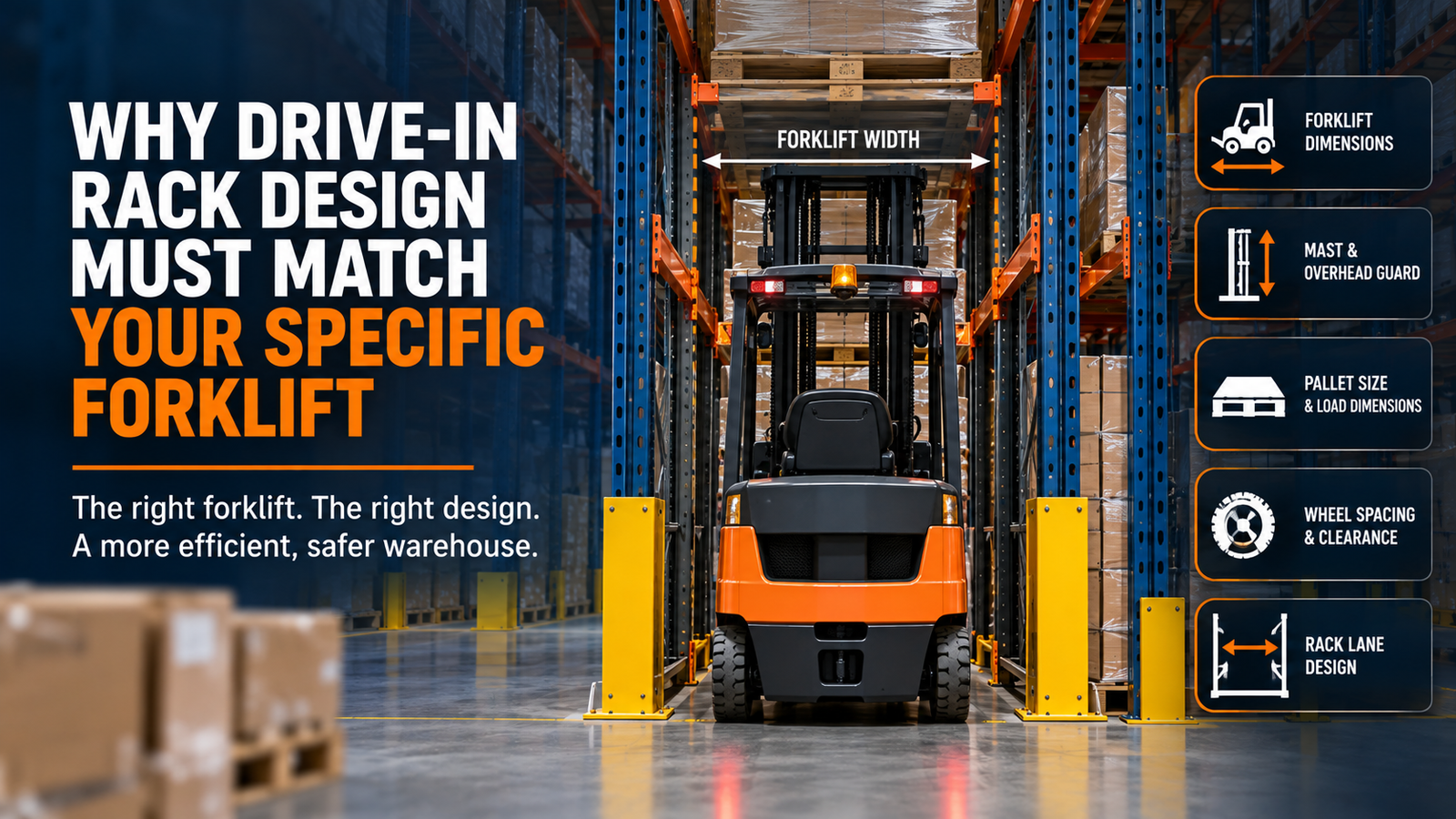
Unlike selective pallet racking, the forklift physically enters a drive-in storage lane. Its overall width, mast, overhead guard, wheel spacing, lift height, forks, pallet dimensions, and load size can therefore affect the final rack design.
This is why forklift compatibility should be considered early in the planning process. If you are still evaluating equipment, Accurate Shelving’s guide to choosing the right forklift for your racking system explains the broader relationship between material handling equipment and warehouse racking.
The goal with drive-in rack design is to provide enough operating clearance for safe, efficient pallet handling without sacrificing valuable storage capacity.
Why Does the Forklift Matter So Much in Drive-In Racking?
The forklift matters because it becomes part of the rack’s operating space. With selective racking, the truck usually remains in the aisle. In a drive-in rack system, it can travel several pallet positions deep between uprights and below elevated pallet levels.
The forklift body, mast, overhead guard, wheels, carriage, forks, and loaded pallet must therefore move through the lane without unnecessary interference with uprights, rails, guide rails, or base plates.
A rack should never be designed around the assumption that any standard forklift will fit. The actual truck dimensions should be reviewed before the layout is finalized.
What Forklift Specifications Affect Drive-In Rack Design?
Several forklift measurements influence rack dimensions, operating clearance, and pallet placement. Looking only at rated lifting capacity is not enough; the complete working envelope matters.
How Does Forklift Width Affect Rack Clearance?
Overall forklift width is one of the most important measurements. The truck needs enough side clearance to move between the uprights without repeated contact. However, making lanes unnecessarily wide can reduce the storage density that makes drive-in pallet racking valuable.
The design should therefore balance practical forklift clearance with efficient use of warehouse space.
Why Do Mast and Overhead Guard Dimensions Matter?
A forklift chassis may fit comfortably while its mast or overhead guard creates a different clearance requirement.
The mast moves inside the rack as pallets are raised, while the overhead guard must pass safely beneath elevated rack components and pallet positions.
Both should be checked before rack openings and rail heights are finalized.
Why Are Lift Height and Capacity at Height Important?
Maximum lift height determines whether a forklift can reach upper pallet positions, but reach alone is not enough.
The truck must also be capable of handling the actual pallet weight at the required elevation. Rack height, load weight, load centre, and forklift capacity should therefore be considered together.
Why Should Wheel Spacing and Base Plates Be Checked?
Forklift wheels travel close to the lower rack structure.
Wheel spacing can affect clearance around base plates, anchors, and floor-mounted guide rails. Guide rails should work with the truck’s wheel configuration rather than obstructing its travel path.
Do Forks, Pallets, and Load Dimensions Matter?
Yes. The forklift should be evaluated while carrying the actual type of load it will handle.
Fork length, carriage width, pallet depth, pallet width, and product overhang can all change the required operating space. A truck that fits easily when unloaded may have considerably less clearance with a full pallet.
Which Forklifts Can Be Used With Drive-In Racking?
There is no single forklift that suits every drive-in rack. Counterbalance forklifts are commonly used, while reach trucks and other equipment can also work when their dimensions are considered during rack design.
Forklifts with wide outriggers, straddle legs, or unusual mast configurations may require additional clearance.
If several forklift models will use the same system, each should be checked individually. A drive-in lane that works for one truck may not provide suitable clearance for another.
How Do Pallet Dimensions Affect Forklift-to-Rack Compatibility?
Drive-in pallet racking must be designed around both the forklift and the pallet. Pallet width affects how the load rests on the support rails, while pallet depth and product overhang influence clearance and positioning inside the lane.
If multiple pallet sizes are used, the rack designer should know this before the system is finalized. Different dimensions can affect rail spacing, load support, and forklift positioning. The best approach is to treat the forklift, pallet, and load as one material handling system.
What Happens When the Forklift and Rack Do Not Match?
A poorly matched forklift may still enter the rack, but operators can be left with very little room to work. Insufficient clearance can lead to repeated corrections, slower pallet handling, forklift impacts, and damage to uprights or rails.
A wide truck may have inadequate side clearance. A tall overhead guard can conflict with elevated rack components, while different wheel geometry may interfere with guide rails or base plates.
Compatibility problems discovered after installation can also become expensive if they require rack modifications, equipment changes, or the loss of usable pallet positions. Good drive-in rack design must therefore balance storage density with practical forklift operation.
How Should Forklift and Drive-In Rack Compatibility Be Checked?
Compatibility should be confirmed before the final rack layout is approved. Start with the exact forklift make and model and review its overall width, mast dimensions, overhead guard height, wheel configuration, forks, maximum lift height, and relevant load capacity.
Next, confirm pallet width, depth, load height, maximum weight, and any product overhang. The warehouse layout also matters. Access aisles, ceiling height, columns, doors, floor conditions, and other obstructions can influence how the truck approaches and enters the storage lanes.
Once these details are known, the rack can be designed around the real operating envelope instead of an assumed forklift size.
Should You Design the Rack Around the Forklift or the Forklift Around the Rack?
Ideally, the forklift and drive-in racking should be planned together. If you already own the forklifts, their dimensions should become design inputs for the new rack system. Rack openings, rail levels, guide rails, and lane dimensions can then be designed accordingly. If the drive-in racking already exists, the process works in reverse.
Before buying a replacement forklift, compare its dimensions with the existing rack. Two trucks with similar lifting capacities can still have different widths, mast profiles, overhead guard heights, or wheel configurations.
The same check should be made before introducing a different forklift model into an existing fleet.
What Rack Features Can Help Reduce Forklift Damage?
Guide rails, protected rack entries, and upright protection can help reduce forklift-to-rack contact.
Floor-mounted guide rails can help keep the truck centred while it moves through the lane, while entry protection can help protect vulnerable rack components. These features improve protection, but they cannot compensate for poor forklift compatibility.
A lane that is too narrow or a rail level that conflicts with the truck still needs to be corrected through proper design.
Is Your Current Forklift Suitable for Drive-In Racking?
A forklift may be suitable when its dimensions, lifting capability, wheel configuration, and loaded operating envelope match the proposed rack design.
Before installation, confirm the truck’s overall width, mast profile, overhead guard height, wheel spacing, lift height, load capacity, fork configuration, and pallet dimensions.
If more than one forklift will use the system, review every model. Compatibility should be confirmed before installation rather than assumed afterward.
Why Should the Rack, Forklift, and Pallet Be Designed Together?
Drive-in racking works best when the rack, forklift, pallet, load, and warehouse layout are treated as one system.
The forklift determines how equipment moves through the storage lane. Pallets affect rail spacing and load support, while the rack determines operating clearance. Considering these factors together can help preserve storage density, improve pallet handling, and reduce unnecessary contact between forklifts and rack components.
Before installing new drive-in pallet racking or replacing a forklift used in an existing system, make sure the complete combination has been reviewed.
Frequently Asked Questions
What Type of Forklift Is Best for Drive-In Racking?
Counterbalance forklifts are commonly used, but suitability depends on truck dimensions, lift height, pallet size, load requirements, and rack geometry.
How Much Forklift Clearance Is Needed in Drive-In Racking?
There is no universal clearance. The correct amount depends on the forklift, pallet and load dimensions, guide system, and engineered rack design.
Can Different Forklifts Use the Same Drive-In Rack?
Yes, but each model should be checked for width, mast profile, overhead guard height, wheel spacing, and operating clearance.
Does Forklift Width Determine Drive-In Rack Lane Width?
Forklift width is a major factor, but mast dimensions, wheels, pallets, loads, and guide rails also influence the required lane geometry.
Can I Replace My Forklift Without Changing the Drive-In Rack?
Possibly. Compare the replacement truck with the existing rack first because similar lifting capacity does not always mean identical dimensions or clearance requirements.