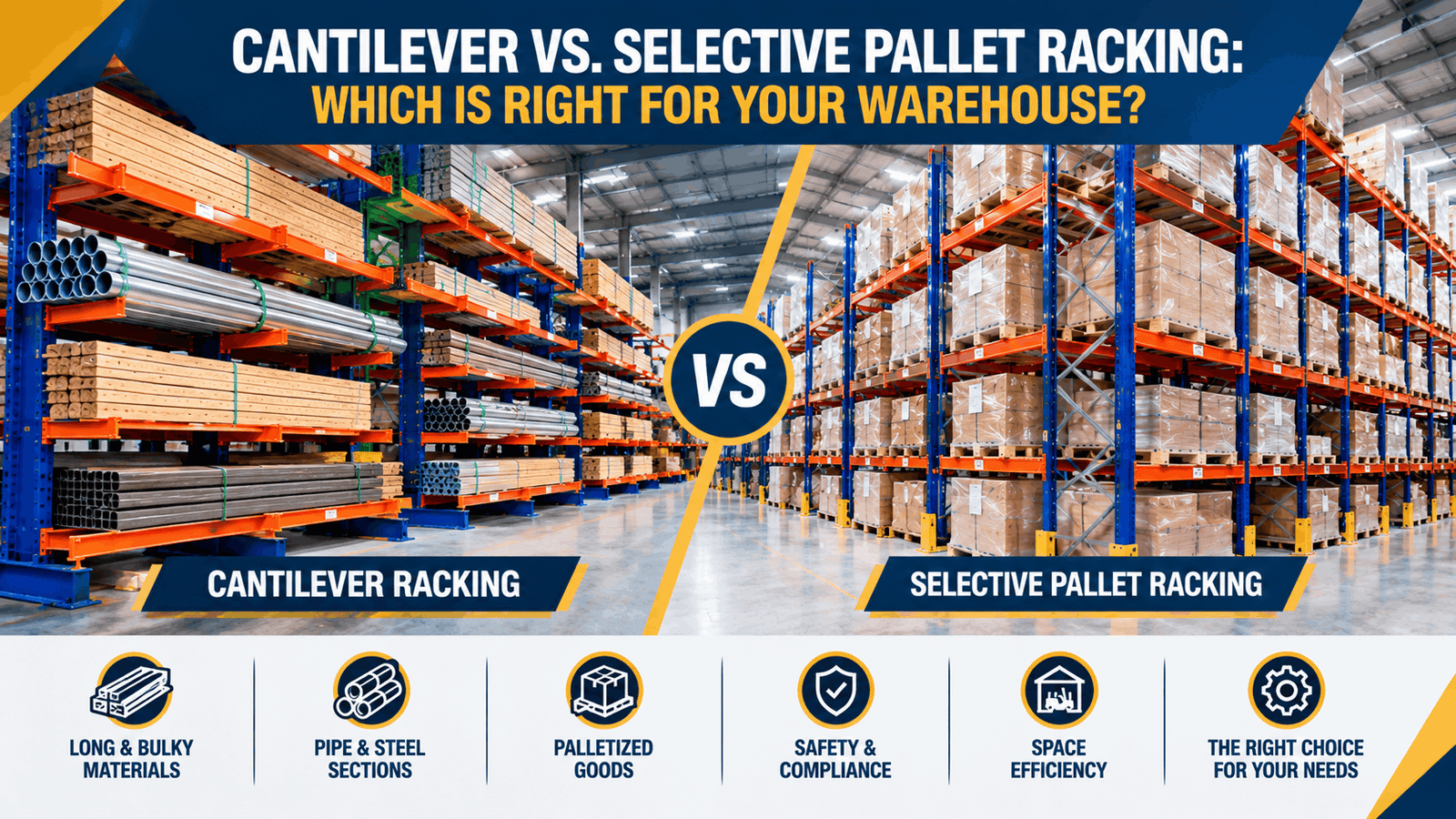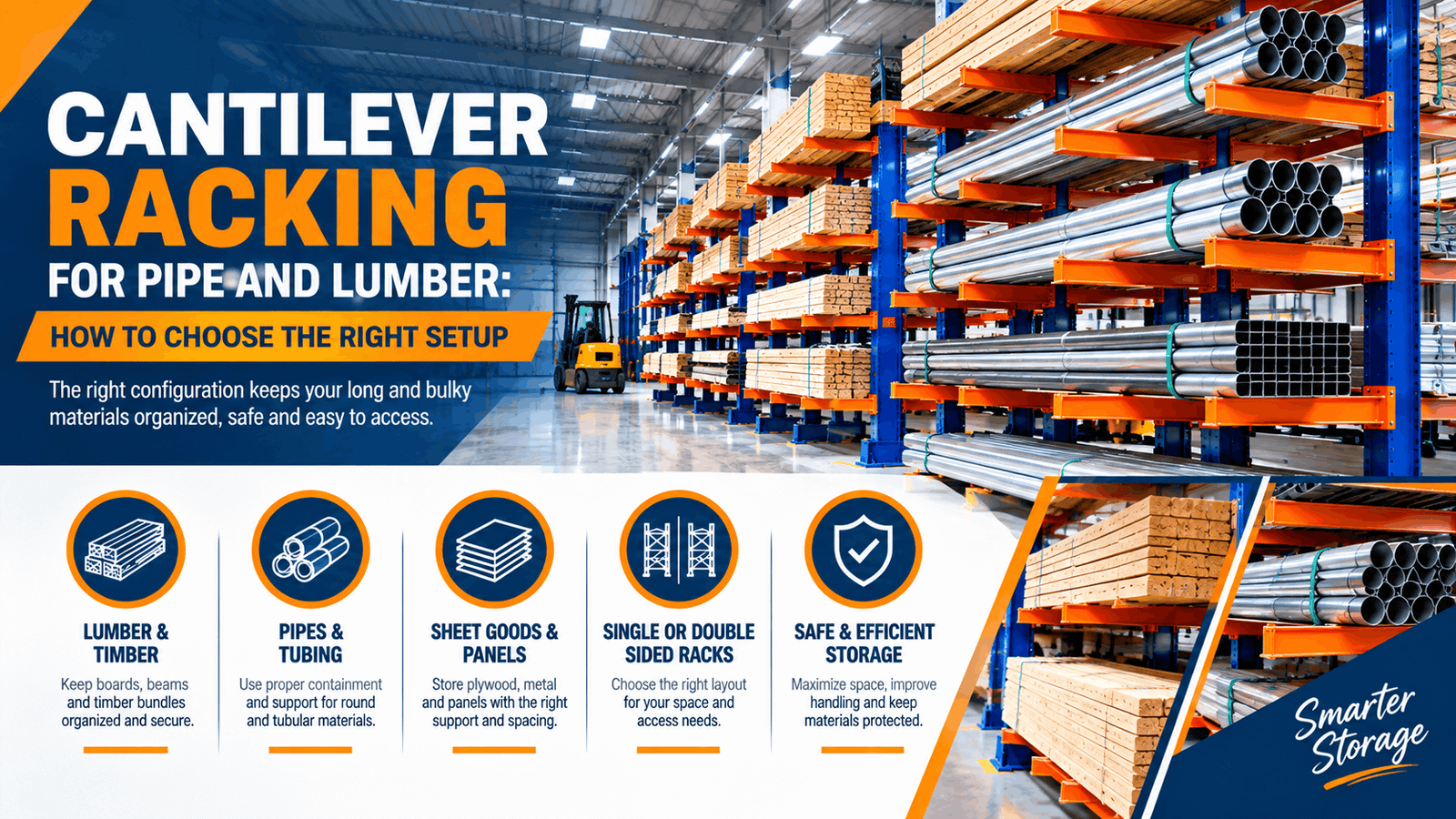
The right cantilever racking setup starts with your material: its length, stored dimensions, weight, support requirements and retrieval method. Pipe needs an appropriate containment arrangement, while lumber needs support suited to the product and bundle. Rack dimensions should follow those requirements.
At Accurate Shelving, we help businesses plan storage around their inventory and daily handling. Our cantilever racking guide explains the system’s basic structure. Here, the focus is choosing a configuration for pipe, lumber and the changing quantities left after picking.
What Should You Measure Before Choosing Cantilever Racking?
Prepare a stock profile before comparing rack sizes.
What Are Your Shortest and Longest Stored Lengths?
Record the full range of lengths, including occasional deliveries and remnants. The longest item affects the space needed to move material, while the shortest helps determine whether each piece reaches suitable supports.
For example, a location planned around full-length stock may not accommodate short pieces returned from cutting. Include those pieces in the planning discussion instead of finding space for them later.
How Heavy and Large Is Each Stored Unit?
Measure the length, depth and height of the actual bundle, including packaging or bearers. Record its maximum weight and the quantities expected after replenishment.
Distinguish strapped bundles from loose stock. Two deliveries of the same material can need different arrangements if their bundle dimensions, weights or picking methods differ.
How Should Arm Length and Support Spacing Be Selected?
Cantilever arms and column positions must form a suitable support arrangement for the material. There is no universal cantilever arm spacing that works for every pipe, timber pack or mixed load.
How Does Load Depth Affect Arm Length?
Arm length must suit the depth and intended position of the stored load. Establish where the material will bear on the arm and how it will be placed and removed.
Longer arms are not automatically better. They affect the rack footprint and must have the appropriate rating for the intended loading arrangement. Give the supplier the actual load dimensions before selecting them.
How Many Supports Does Each Material Length Need?
The number and spacing of supports depend on material length, stiffness, weight and permitted overhang. Flexible stock can behave differently from a rigid bundle of similar dimensions.
Have the complete arrangement specified. A rule such as dividing stock length by a fixed number cannot establish suitability, and adding supports does not prove that the load will be shared equally.
How Much Vertical Space Is Needed Between Levels?
Allow for bundle height and the clearance needed to lift and withdraw it. Include the handling equipment and attachments in that assessment.
Closely spaced levels may look efficient on a drawing but leave insufficient working clearance. Choose usable storage positions rather than the greatest possible number of arms.
What Does Pipe Storage Need That Lumber Storage May Not?
Round pipe can roll or separate, particularly after a bundle is opened. Pipe storage racks therefore need an appropriate retention arrangement as well as sufficient support and capacity.
How Will Loose Pipe Be Kept Under Control?
Discuss arm selection and manufacturer-approved stops or other retention provisions with the supplier. The arrangement must suit the pipe diameter, quantity and handling method.
Do not assume inclined arms alone control every load. Stopper pins are also not capacity upgrades or permission to overfill a position. They form part of a specified storage arrangement.
What Changes When a Pipe Bundle Is Opened?
Explain whether operators retrieve whole bundles or pick individual lengths. Remaining pieces may move differently once packaging is removed, even though the total weight has decreased.
Decide where picking occurs and how loose lengths remain organized. Review shorter pieces separately where they no longer fit the original support positions.
How Should Lumber Bundles and Mixed Lengths Be Organized?
Lumber storage racks should suit both incoming packs and the material used during normal work. Consider access and support at different stock levels, rather than only when every location is full.
Are You Retrieving Full Packs or Individual Boards?
Full-pack movement and individual-board picking create different access requirements. Explain which method applies to each stock group and whether packaging or bearers affect the contact points.
Keep frequently retrieved material in practical locations. Suitable racking helps organize stock, but it should not be presented as a guarantee against warping or deterioration; material care and environmental conditions still matter.
Where Will Short Pieces and Returned Stock Go?
Assign suitable locations for remnants and returns. For example, a workshop receiving long timber packs may also accumulate short usable pieces that need a separately approved support arrangement.
Keep stock identified by dimensions and material type. Do not bridge support gaps with improvised boards or leave short pieces balanced on unsuitable arms simply because they weigh less.
How Do You Verify Cantilever Rack Load Capacity?
Cantilever rack load capacity belongs to the configured system. An arm’s rating does not independently establish what the columns, bases, connections and installation can support.
Do the Ratings Match the Actual Loading Arrangement?
Confirm the approved load per arm, load position, number of loaded levels and column configuration. The documentation must describe how you intend to use the rack.
Dividing a bundle’s weight by its number of supports gives an average, not proof of the force carried by each arm. Uneven contact or material behaviour can change load sharing. Have the proposed loading arrangement verified.
What Requires Review When Inventory Changes?
Review heavier bundles, new stock lengths, changed arm positions and replacement components before treating them as equivalent to the original setup.
Keep drawings and load information accessible to the people managing the storage area. A location label helps only when its stated limits still match the rack and inventory assigned there.
Which Layout Gives Your Equipment Enough Access?
The rack footprint is only part of the required space. The layout must also accommodate the loaded equipment approaching, lifting, withdrawing and turning with long material.
Should the Rack Be Single-Sided or Double-Sided?
Single-sided cantilever racking can suit perimeter locations where access is needed from one face. Double-sided arrangements can suit central rows with usable access on both sides.
Compare the complete footprint and access requirements. Have loading conditions on each side specified rather than assuming operators must keep both sides equally loaded to maintain stability.
Can the Forklift Manoeuvre With Your Longest Load?
Check the actual truck, attachments and longest handled bundle together. A forklift fitting between racks does not establish that a long load can turn or be withdrawn within that space.
Good warehouse layout planning accounts for those movements alongside doors, columns and adjoining activity. Avoid copying a generic aisle width from an unrelated facility.
What Should You Confirm Before Ordering?
Bring together the stock profile, support requirements, handling equipment and available space. Identify whether the rack will be indoors or outdoors and provide information about the intended support surface.
Outdoor finishes, exposure and covered storage need project-specific review. Do not assume an indoor system can be moved outside or fitted with a roof without checking its suitability.
Accurate Shelving’s cantilever racking systems form part of our storage range. Discuss the proposed configuration, approved loads, drawings and installation requirements before ordering so equipment selection follows the work it must perform.
Final Thoughts:
Choose the setup around each material group’s support, capacity, containment and access needs. Include opened bundles and shorter remaining stock in the plan, not just full incoming loads.
Discuss your cantilever storage requirements with Accurate Shelving. Share stock lengths, bundle dimensions, maximum weights and handling details to discuss a suitable configuration and request an estimate.
Frequently Asked Questions
Can Pipe and Lumber Share the Same Cantilever Rack?
They may, provided each assigned position has suitable support, capacity and containment. Give the supplier details of both materials and how each will be retrieved.
Is There a Standard Cantilever Arm Spacing?
No single spacing suits every load. Material stiffness, length, weight and permitted overhang influence the arrangement. Have support positions specified for your actual stock.
Do Pipes Always Require Inclined Arms?
Not necessarily. Arm selection and retention must suit the approved arrangement. Neither the arm angle nor a stopper pin alone establishes that a pipe load is adequately controlled.
Can Short Offcuts Stay on the Same Rack?
Only where an appropriate support arrangement has been confirmed. Short pieces should not be placed in positions designed solely for longer stock or supported with improvised bridging.
Can Existing Cantilever Arms Be Moved to Add More Levels?
Changes need a configuration and capacity review before use. Confirm component compatibility, clearance and the complete loading arrangement rather than assuming spare connection positions authorize additional levels.