Inventory rarely stays the same size and shape forever, but a lot of warehouse racking gets designed as if it will. Adjustable pallet racking solves that mismatch by letting beam heights change as the products stored on them do, instead of locking a warehouse into one fixed layout.
At Accurate Shelving, this guide breaks down what adjustable pallet racking actually is, how the adjustment mechanism works, and what real benefits it delivers over a fixed system.
What Is Adjustable Pallet Racking?
Before getting into how it works, it helps to understand exactly what sets this system apart from a fixed one.
Beam levels that move instead of staying fixed
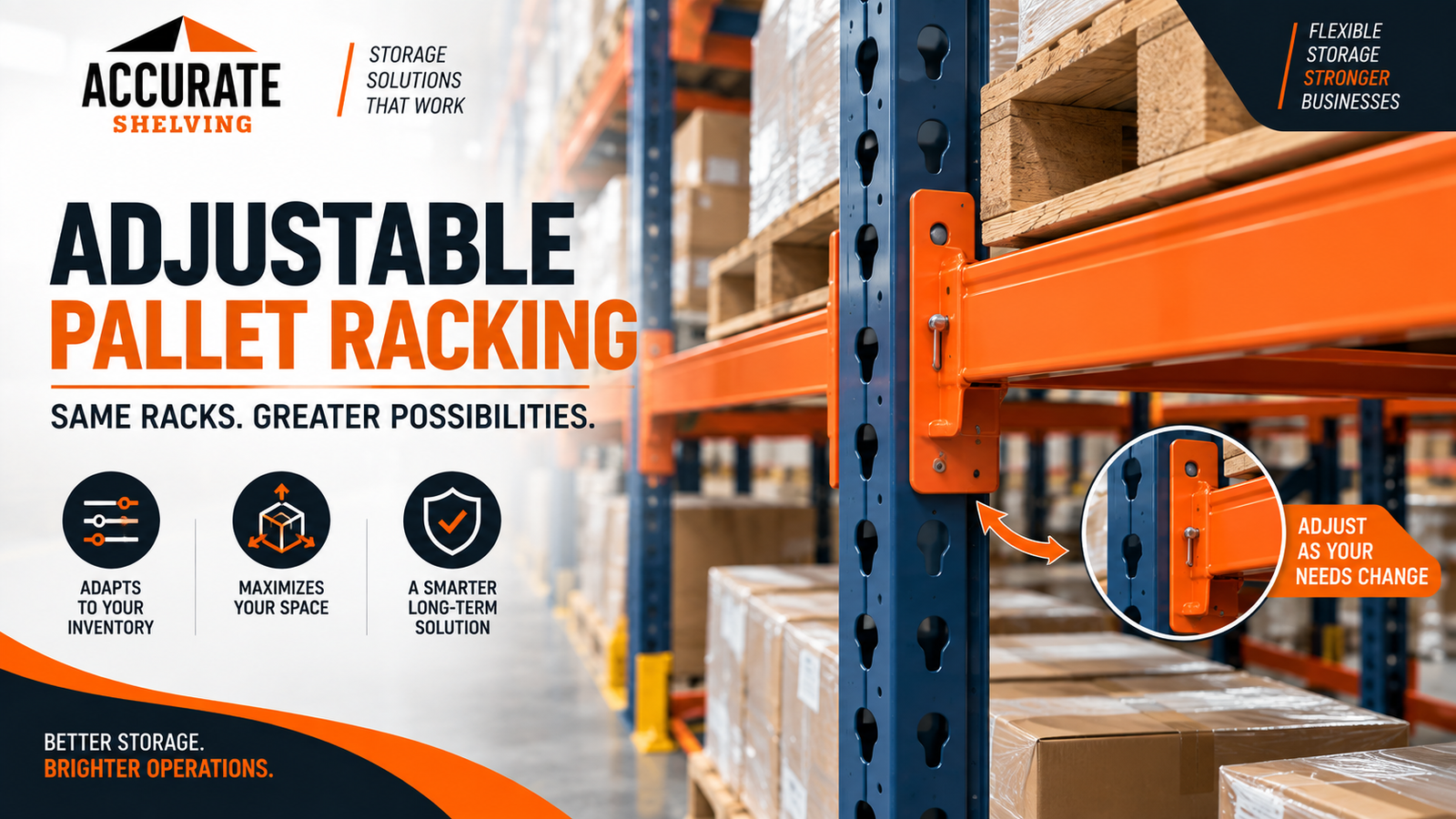
Adjustable pallet racking uses horizontal beams that can be repositioned along the height of the vertical frames, rather than beams welded or bolted permanently into place at a single level.
A feature of selective racking, not a separate system
This adjustability is what defines standard selective racking in the first place, giving every pallet position direct access while still allowing the layout to change as needs do over time.
How Does Beam Height Adjustment Actually Work?
Once the basic concept is clear, the mechanics behind it are simpler than most people expect.
Teardrop connectors make adjustment tool-free
Beams attach to uprights through teardrop-shaped holes and safety locking clips, which allow a beam to be unclipped, repositioned, and resecured without cutting or welding anything.
Adjustment happens in set increments, not anywhere along the frame
Beam levels typically shift in one to four-inch increments depending on the upright style, which is precise enough to match most pallet height variations without guesswork or custom fabrication.
How Does Adjustable Pallet Racking Maximize Storage Space?
Space efficiency is one of the clearest, most tangible benefits, and it comes down to a simple idea executed well.
Matching beam height to product height eliminates wasted space
A beam level set too high above a shorter pallet leaves usable vertical space sitting empty, while adjustable beams let that spacing tighten to match what’s actually being stored on that level.
Clearance requirements still have to be respected
A few inches of vertical clearance above the load and a few inches of horizontal clearance around it are still necessary for safe forklift handling, so tightening spacing has real, practical limits.
How Does Flexibility Benefit a Growing or Changing Warehouse?
Beyond the space savings, the real long-term value shows up as a business and its inventory evolve.
Inventory changes without requiring new racking
As product dimensions, packaging, or SKU mix shift over time, beam levels can be reconfigured to match, avoiding the cost and disruption of replacing an entire storage system.
The same frames support years of changing operations
A rack frame installed today can be reconfigured repeatedly over its service life, which is part of why adjustable systems remain the most common racking type in North American warehouses.
What Safety Considerations Apply When Adjusting Beam Heights?
Reconfiguration feels simple in practice, but it isn’t purely a maintenance task, and treating it that way can create real risk.
Reconfiguration can affect the rack’s approved capacity
Moving beam levels can affect the system’s originally approved load capacity, which is why proposed changes should be compared against the original configuration before they’re actually made on the floor.
Load plaques need to reflect the current setup
If a reconfiguration changes the approved capacity or layout, the load plaque should be updated to match, keeping the documented rating consistent with what’s actually installed. That’s the same principle behind proper warehouse racking installation and the ongoing maintenance a racking system needs over its working life.
Which Industries Benefit Most from Adjustable Pallet Racking?
Certain operations get more value from this flexibility than others, simply because of how unpredictable their inventory tends to be.
Food and beverage operations with varied pallet sizes
Mixed inventory with different pallet heights and packaging types benefits from beam levels that can be tuned to each product, an approach we’ve covered in more depth for food and beverage storage specifically.
Automotive and 3PL operations with unpredictable inventory
Automotive parts of irregular shapes and 3PL facilities serving multiple clients both depend on the same flexibility, since neither can predict exactly what will need to be stored a year from now.
Getting Adjustable Pallet Racking Right
Adjustable pallet racking earns its place as the most common racking system by solving a problem every warehouse eventually faces: inventory that doesn’t stay the same forever.
Accurate Shelving has spent over 21 years designing and installing pallet racking systems across Canada, built around how your inventory actually changes over time. Visit our About Us page to learn more, or reach out through Contact Us for a hands-on assessment of the right racking configuration for your warehouse.
Frequently Asked Questions
What makes pallet racking “adjustable”?
The horizontal beams can be repositioned along the height of the vertical frames using teardrop connectors and safety locks, rather than being fixed permanently in place.
How much can beam heights typically be adjusted?
Most systems adjust in increments of one to four inches, depending on the upright style, giving enough precision to match common pallet height variations.
Does adjusting beam heights require special tools?
No, teardrop connector systems are designed for tool-free adjustment, though loads need to be removed from the beam before it’s repositioned.
Can beam height changes affect a rack’s safety rating?
Yes, certain reconfigurations can affect the system’s originally approved capacity, so changes should be compared against the original configuration and documented accordingly.
Why is adjustable pallet racking the most common racking type?
It combines direct access to every pallet position with the flexibility to adapt as inventory changes, without requiring an entirely new system.