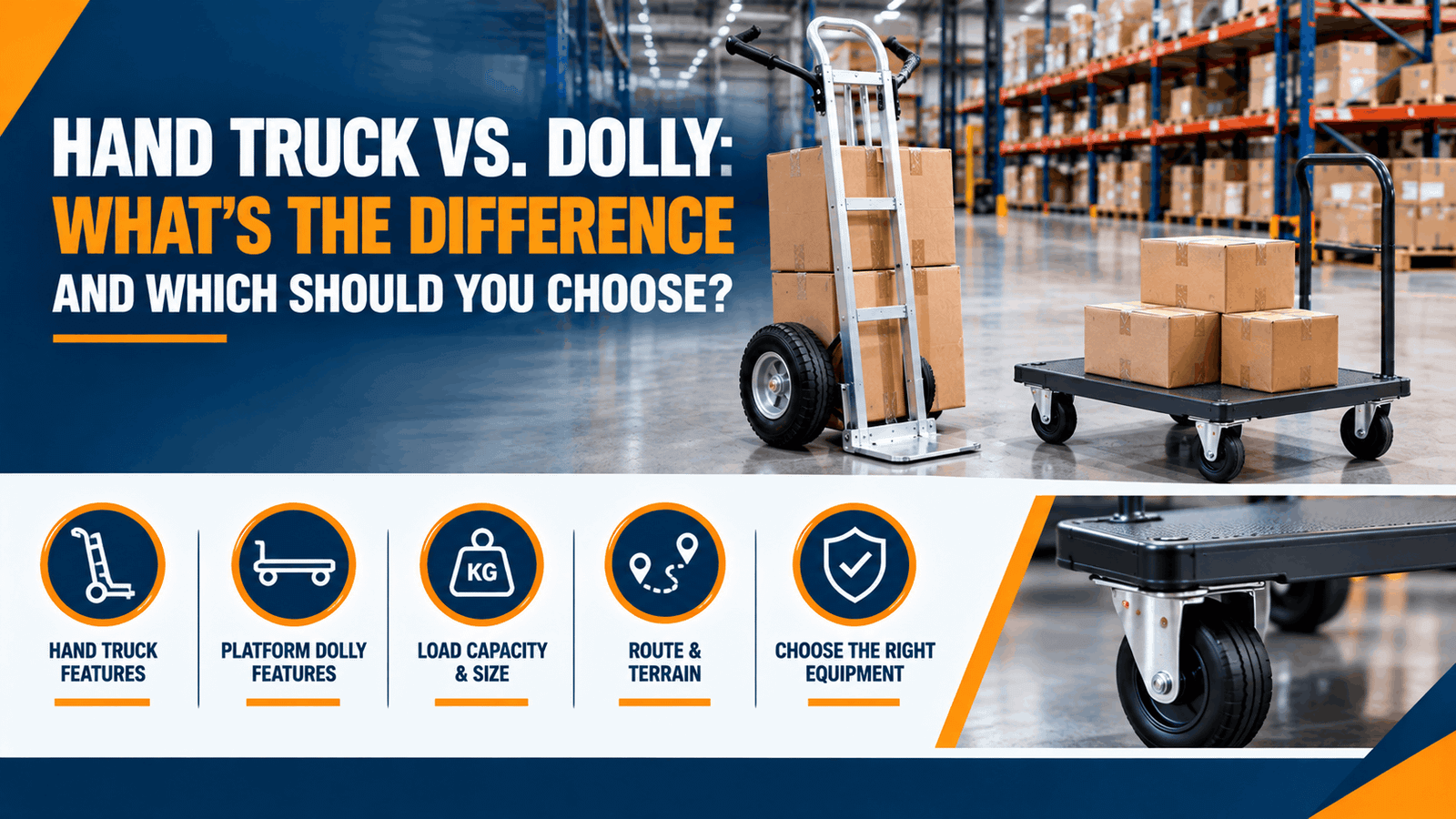
A hand truck usually has an upright frame, two wheels and a nose plate that supports a load while it is tilted back. A platform dolly carries items on a flat wheeled base. However, “dolly” is also a common name for a two-wheel hand truck, so the equipment’s design matters more than its label.
At Accurate Shelving, we help businesses match handling equipment to what they move and where it travels. The hand truck vs. dolly decision starts with the load, loading method and route, not simply the highest advertised capacity.
What Is the Difference Between a Hand Truck and a Dolly?
Both move goods, but they support them differently. In this guide, “hand truck” means the upright two-wheel design, while “platform dolly” means a flat wheeled base. Checking a product photograph and specification avoids confusion when requesting equipment.
How Does a Two-Wheel Hand Truck Support a Load?
A nose plate, also called a toe plate, fits beneath the load. The upright frame supports its back, and the operator tilts the equipment to balance the load over the wheels.
This arrangement can suit stacked cartons and compatible upright loads. It still requires effort and control when loading, tilting, turning and unloading.
Our Magliner hand trucks provide options for commercial material movement and route distribution. Match the frame, plate and wheels to the actual task.
How Does a Platform Dolly Differ From a Platform Truck?
A platform dolly supports goods on a flat base, typically with four wheels. Some low-profile designs have no upright handle. A platform truck generally includes a handle for moving the loaded platform.
Accurate Shelving supplies material handling carts and platform trucks specified around deck size, caster type and intended loads. Those details matter more than whether someone calls the equipment a cart, truck or dolly.
When Should You Choose a Hand Truck?
Choose an upright hand truck when the load fits its nose plate and frame and can be tilted and controlled safely. It can be practical for repetitive carton movement, but suitability depends on the complete loaded arrangement.
Are You Moving Stacked Cartons or Upright Loads?
A hand truck can support compatible cartons against its frame while their base rests on the plate. This can suit trips between a stockroom and a delivery area.
Check that the load remains stable and use any securing arrangements required by the manufacturer. Wide, irregular items or weak packaging may not have suitable support, even when their total weight is below the rating.
An ordinary hand truck should not automatically be treated as suitable for every appliance or awkward load.
Does Your Route Have Limited Turning Space?
A two-wheel hand truck can be convenient in restricted routes, but measure the loaded width and turning space. A carton extending beyond the frame can change what fits through a doorway.
Also check visibility. A tall stack that blocks the operator’s view creates a handling problem regardless of whether it clears the door.
When Should You Choose a Platform Dolly or Platform Truck?
A platform design deserves consideration when goods need a broader supporting surface and can travel along a suitable route. It avoids balancing the load continuously on two wheels, but loading and movement still require planning.
Does the Load Need a Larger Supporting Surface?
Containers, cases and bulky items may sit more naturally on a deck than on a small toe plate. Confirm that the platform supports the load appropriately and that it remains stable through turns and stops.
Four wheels do not automatically mean greater capacity. Use the model’s verified rating and loading conditions, including any restrictions on concentrated loads. A large platform is only useful if it fits the route as well as the goods.
Are You Moving Several Items Across a Level Floor?
A platform truck can carry suitable grouped loads between receiving, storage and work areas. The handle provides a defined position for controlling the equipment.
The trade-off is space: the deck, load and handle need room to turn and park. Small casters may also struggle at gaps or thresholds, so a smooth-looking route should still be checked from start to finish.
How Do Weight, Loading and Route Conditions Affect Your Choice?
Rated capacity is one selection factor. Load geometry, manual effort, wheel suitability and the route determine whether the equipment works practically during repeated use.
How Should You Compare Rated Capacity and Load Fit?
Record the heaviest expected load, including its packaging. Compare its dimensions, support points and distribution with the manufacturer’s requirements.
For a convertible hand truck, check the rating in the operating mode you intend to use. A platform-mode rating should not be applied to upright operation.
Do not assume that being below the weight limit makes an unstable or poorly supported load acceptable.
How Will You Load and Unload the Equipment?
A platform may provide broad support once loaded, yet getting an item onto it can require lifting or assistance. A hand truck may reduce some carrying, but tilting a heavy load still requires effort.
Consider where the goods start and finish. Moving a carton from the floor presents a different task from transferring it between raised surfaces. Select equipment around the whole movement, not just the rolling portion.
Do Wheels, Thresholds or Slopes Change the Decision?
Check floor joints, thresholds, outdoor sections and gradients. Wheel diameter, material and caster arrangement affect movement and control; no single wheel type suits every route.
Stairs and ramps require equipment specifically suitable for the task and operation according to its instructions. Do not assume a standard hand truck can handle stairs or that an unbraked platform can be controlled on a slope.
Repeated trips also matter. Equipment that is awkward to steer or lift into a vehicle becomes a larger problem when that action happens throughout a shift.
When Is a Convertible Hand Truck Worth Considering?
A convertible hand truck combines upright and platform operating modes. It can be useful when tasks change, provided both configurations suit the loads and routes involved.
Do Your Tasks Alternate Between Upright and Platform Loads?
For example, a stockroom might move suitable stacked cartons on one trip and several containers on the next. A two-in-one hand truck can offer both support arrangements without requiring two separate units.
However, conversion hardware can add equipment weight and complexity. Check the operating instructions, locking arrangements and space needed in each mode.
Our Magliner handling-cart guide explores configurations and accessories in more detail. A convertible option should earn its place through regular use of both modes, rather than flexibility alone.
What Should You Check Before Ordering?
Describe the work instead of asking only for a “heavy-duty dolly.” Provide the heaviest load, dimensions, loading method and frequency of use.
Measure the narrowest doorway and available turning space. Explain floor conditions, thresholds, gradients and any vehicle transport. Account for where the equipment will be stored when not in use.
Photographs can help explain the route, but measurements and model specifications are still needed. Confirm the proposed configuration and its operating requirements before purchase.
Final Thoughts
Choose an upright hand truck for compatible loads that can be tilted, supported and controlled. Choose a platform design when flat support better suits the goods and route. Consider a convertible model when both modes solve recurring tasks.
Request equipment advice or an estimate from Accurate Shelving. Share what you move, how much it weighs and where it travels so suitable options can be compared around your operation.
What Else Should You Know About Hand Trucks and Dollies?
These common questions clarify equipment names, capacity and intended use.
Is a Dolly the Same as a Hand Truck?
Sometimes. “Dolly” can describe a two-wheel hand truck or a flat platform design. Specify the support arrangement and check the equipment’s photograph and specifications.
Does a Four-Wheel Dolly Always Carry More Weight?
No. Capacity depends on the model, load distribution and operating conditions. Compare verified ratings rather than assuming the number of wheels establishes the weight limit.
Can a Standard Hand Truck Be Used on Stairs?
Do not assume so. Confirm that the equipment is suitable for the specific stair task and follow its instructions, load limits and required operating procedures.
What Is a Convertible Hand Truck?
It changes between upright two-wheel and platform operating modes. Each configuration may have different capacity, dimensions and operating requirements, which must be checked separately.
Is a Hand Truck the Same as a Pallet Jack?
No. An upright hand truck supports compatible individual loads on a nose plate. A pallet jack uses forks to lift and move suitable palletized loads.