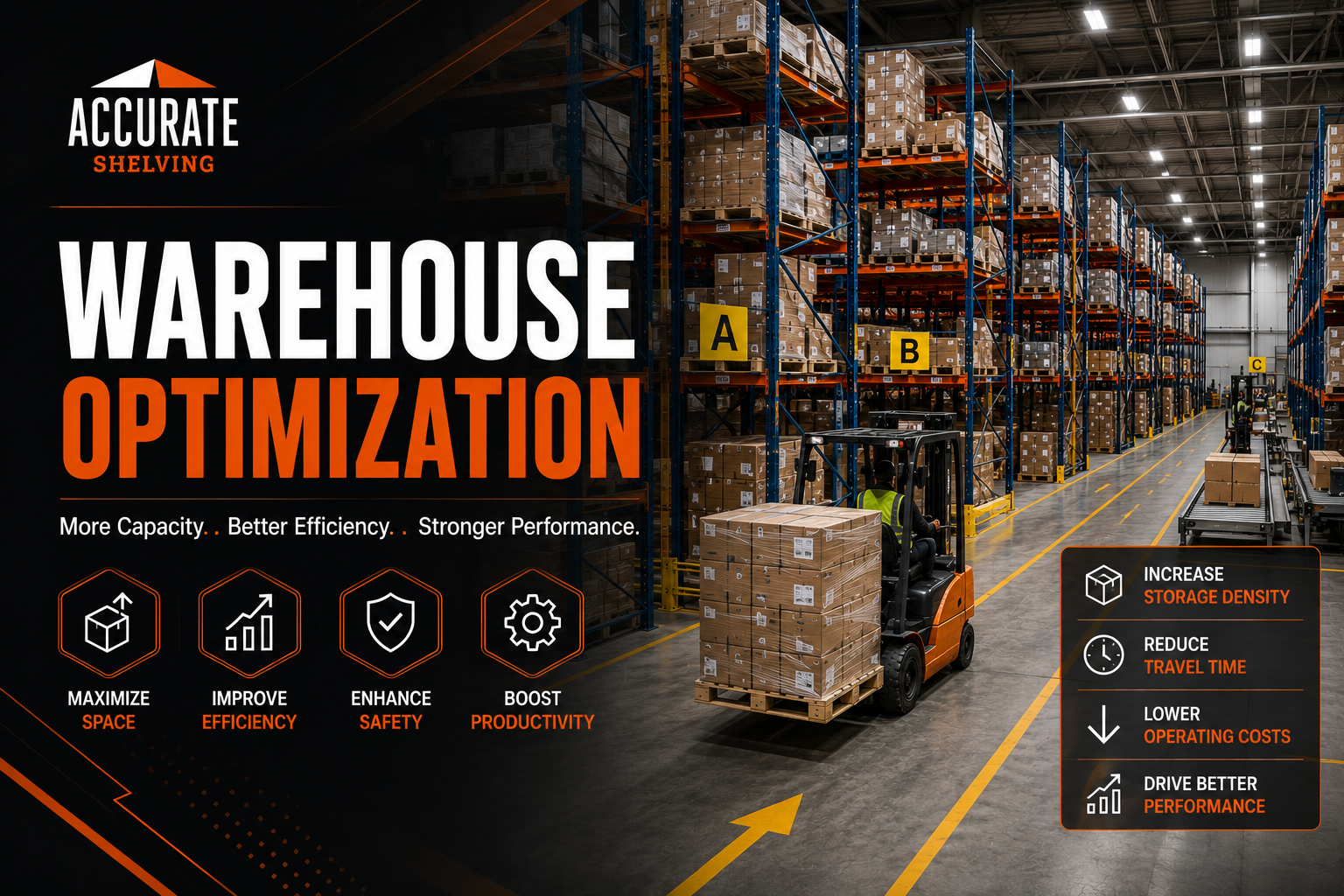
Most warehouses aren’t actually short on space. They’re short on a plan for the space they already have. Real estate keeps getting more expensive, and labor keeps getting harder to find, which means the fastest, cheapest capacity increase is usually sitting inside the four walls you already own, not in a bigger building down the road.
At Accurate Shelving, we spend most of our time helping facilities find that warehouse optimization rather than expand into new square footage. This guide breaks down the proven strategies that actually increase capacity and efficiency, from racking and layout to workflow and technology.
What Does Warehouse Optimization Actually Mean?
Warehouse optimization gets used as a buzzword often enough that it’s worth pinning down what it actually means in practice.
More than a buzzword – a measurable outcome
Warehouse optimization means every square foot, every aisle, and every step a picker takes is working toward capacity and speed, not just sitting there because that’s how the warehouse design happened to turn out originally.
Why it matters more now than it used to
Rising real estate costs, ongoing labor shortages, and growing e-commerce order volume are pushing more warehouses to get more out of existing space rather than sign a lease on a bigger one.
How Do You Increase Storage Capacity Without Expanding Your Footprint?
This is where most of the real, measurable gains happen, and it rarely requires adding a single square foot of new building.
Reduce aisle space without sacrificing safety
Adjusting aisle widths to the narrowest safe configuration for your equipment can meaningfully increase usable storage, since every foot of aisle that isn’t needed is a foot that could be holding inventory instead.
Build vertically with mezzanines and high-rack systems
Multi-level mezzanines and taller racking configurations can add significant storage capacity by putting ceiling height to work instead of leaving it empty above shorter runs of shelving.
Match inventory levels to the space you actually have
Regularly reviewing inventory-to-space ratios prevents the slow creep of overstock that quietly eats into usable capacity long before anyone notices the warehouse feels crowded.
Which Racking Systems Actually Optimize a Warehouse?
The right racking system does more to increase usable capacity than almost any other single decision in a warehouse.
Selective racking for accessibility across varied inventory
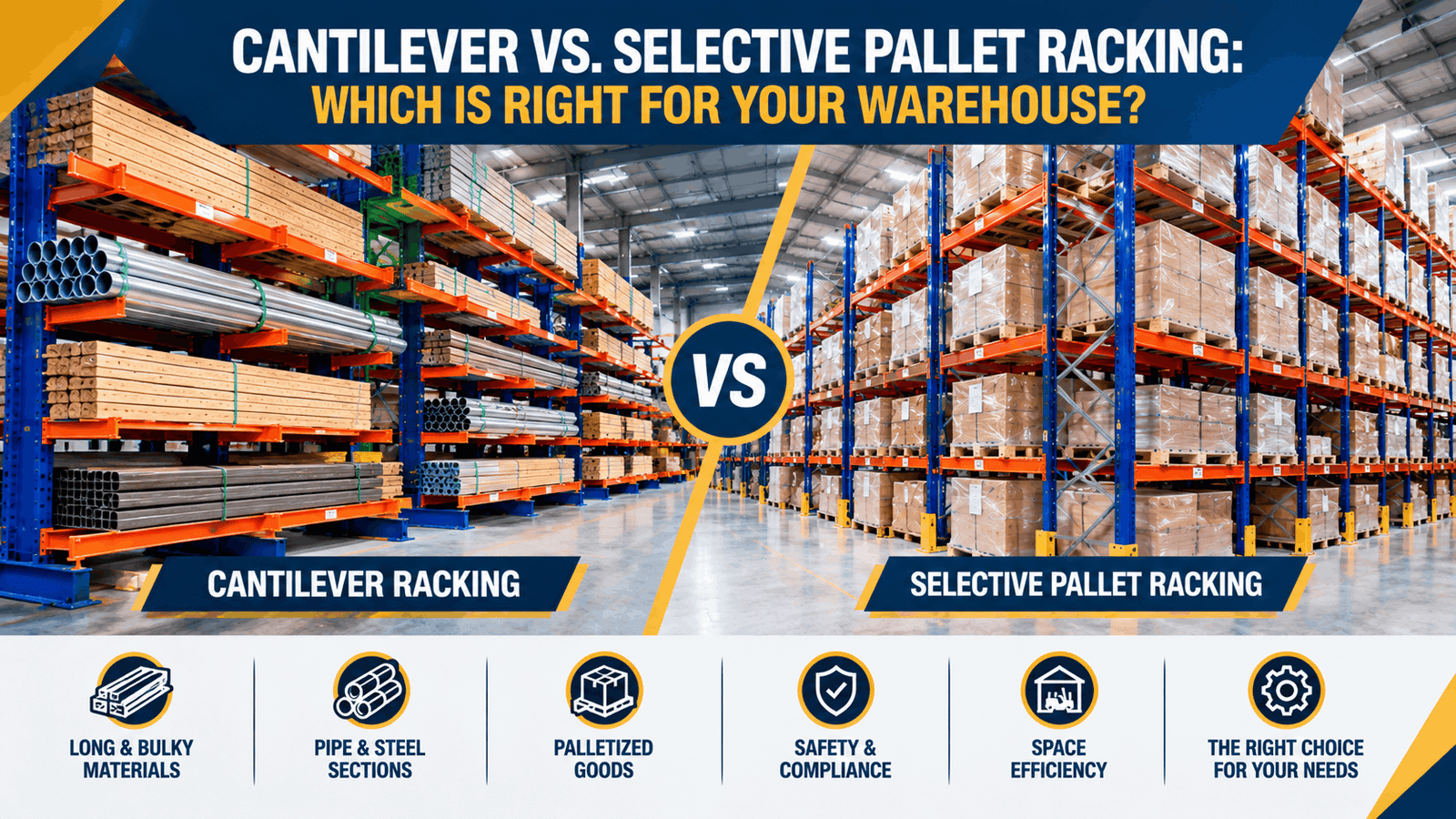
Selective racking keeps every pallet position individually accessible, which suits operations with a wide mix of SKUs and different rotation speeds across their inventory.
Pushback racking for higher density without losing flexibility
Pushback racking stores multiple pallets deep on gravity-fed lanes while still keeping several SKUs accessible across different lanes, making it one of the more efficient middle-ground options between selective and drive-in systems. It’s also the system that tends to matter most in cold storage environments, where every foot of cooled aisle space carries a real energy cost.
Cantilever racking for long or awkward loads
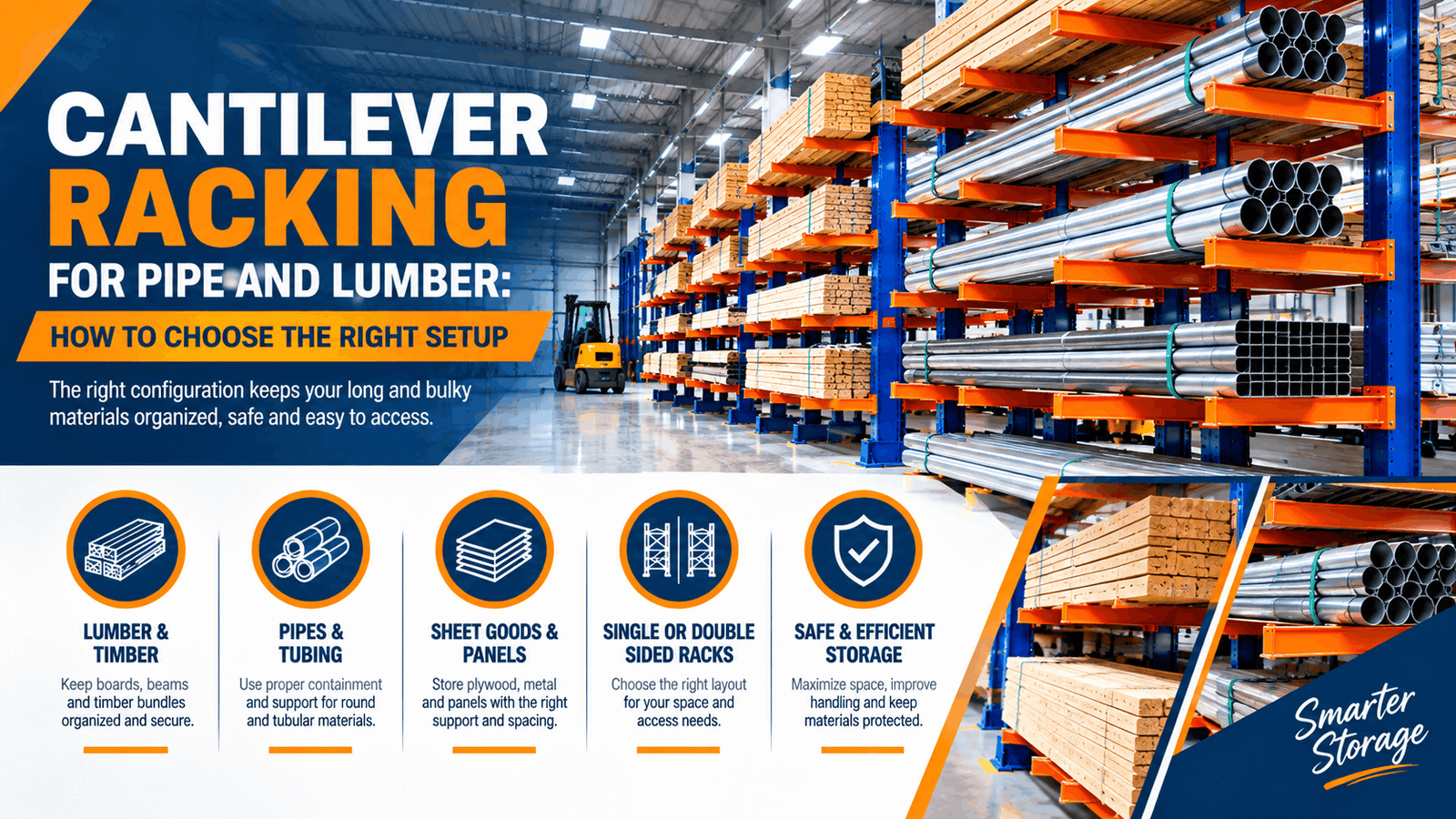
Cantilever racking’s open-front, column-free design handles lumber, piping, and other oversized material that standard pallet racking can’t accommodate efficiently.
How Can Workflow Changes Improve Warehouse Efficiency?
Racking and layout set the ceiling on capacity, but workflow decisions determine how efficiently that capacity actually gets used day to day.
Travel time is the hidden cost of a bad layout
Picker travel time can account for as much as half of total picking time, which makes layout one of the fastest paths to real efficiency gains in almost any warehouse.
Slot inventory by pick frequency, not alphabetically
Placing high-frequency items closest to packing and shipping cuts down on the distance covered per order, often more than any single piece of new equipment would. This matters even more in operations juggling a high volume of small parts, where poor slotting turns into constant backtracking across the floor.
Fix bottlenecks at receiving and put-away
Inefficient put-away processes create backlogs that ripple through the rest of the operation, even when picking itself is already well organized. Much of that bottleneck comes down to whether the right material handling equipment is available and positioned where receiving actually needs it.
What Role Does Technology Play in Warehouse Optimization?
Technology supports warehouse optimization, but it works best as a layer added on top of good physical decisions, not a substitute for them.
A warehouse management system as the operational backbone
Real-time inventory tracking and data-driven slotting through a warehouse management system keep fast-moving items positioned exactly where they’re needed most.
Automation as an advanced, not default, layer
Automated storage and retrieval systems add real efficiency at scale, but they perform best layered onto a warehouse that’s already well laid out, rather than serving as a substitute for good racking and layout decisions in the first place.
What Does a Warehouse Optimization Process Look Like?
A strong optimization project follows a process, rather than starting with equipment purchases before anyone has actually diagnosed the problem.
Start with an honest assessment of what’s not working
Walking the floor to identify hazards, bottlenecks, and underused space is the starting point for every effective optimization project, before any racking or layout changes get made.
Set specific, measurable goals before making changes
Whether the goal is more capacity, fewer accidents, or faster fulfillment, a clear objective shapes which strategies are worth pursuing first and which can wait.
Treat optimization as ongoing, not a one-time fix
Inventory profiles, order volumes, and business needs keep changing, so periodic review keeps a warehouse from drifting back into the same inefficiencies a few years later. This is also worth revisiting anytime a warehouse relocation is on the table, since a move is a natural opportunity to fix problems the old layout never let you touch.
Getting Warehouse Optimization Right
Warehouse optimization is rarely about needing more space. It’s about using the space already there with intention, from aisle widths and racking types to picking sequence and technology layered carefully on top.
Accurate Shelving has spent over 21 years designing, supplying, and installing the racking and layout systems that make optimization physically possible, not just theoretical. Visit our About Us page to learn more, or reach out through Contact Us for a hands-on warehouse optimization assessment tailored to your facility.
Frequently Asked Questions
What’s the fastest way to increase warehouse capacity without expanding?
Reducing aisle width to the safe minimum for your equipment and adding vertical storage through mezzanines or taller racking typically delivers the quickest capacity gains.
How much of picking time is actually spent on travel?
Travel time can account for up to half of total picking time, making layout one of the highest-impact areas to optimize.
Does warehouse optimization always require new technology?
No, many gains come from layout, slotting, and racking changes first, with technology like a warehouse management system layered on to support those improvements.
How often should a warehouse be reviewed for optimization opportunities?
Regularly, since inventory levels, order volumes, and business needs change over time and can gradually erode earlier efficiency gains.
Which racking system adds the most capacity for mixed inventory?
Pushback racking tends to offer the best balance for mixed SKUs, storing multiple pallets deep while still keeping several products accessible across different lanes.